
Symbolism Across Faiths
This term, our pupils have been decoding the symbolic language of faith. We have explored how religious expression acts as a bridge between beliefs and practices, allowing people to communicate their deepest beliefs through the "visible signs" of worship, storytelling, and celebrations.
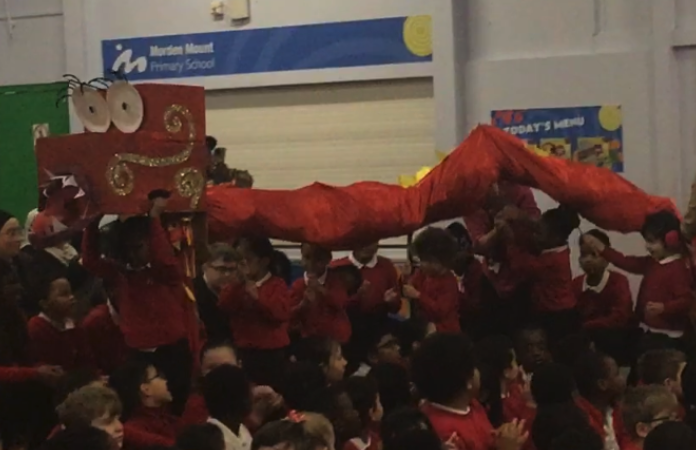
Year of the Horse - EYFS
In Reception, our youngest pupils embarked on a vibrant journey into the Lunar New Year, discovering how celebrations act as a living map for a community's beliefs and traditions. The children explored the specific symbolism of the Horse, learning how it represents energy and strength for our Chinese families and the wider community. They investigated how an animal can become a symbol carrying hopes for the year ahead. This photograph captures our pupils’ immersive learning as they performed the Chinese Dragon Dance.
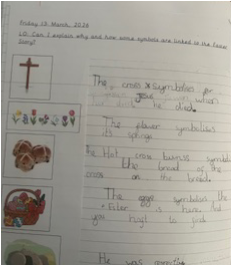
Symbolism Across Faiths - KS1
Throughout the school, pupils have used enquiry-based learning to investigate the concept of symbolism across various faiths. By asking deep, reflective questions, they have uncovered how physical items can represent complex religious ideas. In Year 2, pupils applied this concept to the Christian festival of Easter. This photograph celebrates a pupil’s ability to connect traditional Easter symbols with the core themes of beliefs and practices in Christians within our community.
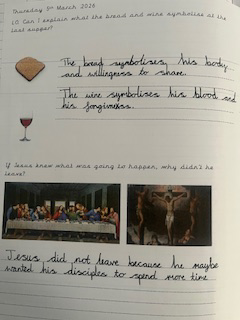
Christianity and the Eucharist - LKS2
In Year 4, pupils expanded their understanding of religious symbolism by examining its role within Christian practices and beliefs. This unit built upon the foundation laid in Key Stage 1, where children first explored how physical objects can hold special meanings. The curriculum moved beyond simple identification toward a deeper exploration of symbols.This picture celebrates a pupil’s interpretation of the Eucharist, demonstrating their understanding of how these symbols connect the Christians to their faith.
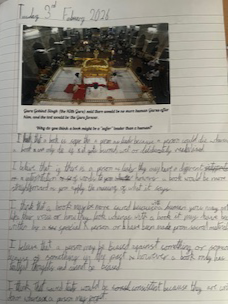
Guru Granth Sahib - UKS2
In this unit, pupils explored the central role of the Guru Granth Sahib within Sikhism, focusing on its significance as both a sacred text and a living leader. Pupils examined why the sacred text is elevated on a palki (throne) within the Gurdwara. To deepen their understanding, the pupils tackled complex evaluative questions, such as: What constitutes a sacred text? Why might a book be considered a more reliable or "safer" leader than a human being? This photograph celebrates a pupils personal reflection on the significance of learning from a written text?